Saturday, September 11, 2010

Outlive Your Life by Max Lucado


We all want to leave a legacy. And when we're gone, and that's all that's left, we want it to be good. Max Lucado speaks to this desire in his latest work, “Outlive Your Life.” What can we do while we are here on earth that will last far longer than our life? Using the book of Acts as his backdrop, Lucado speaks globally and locally in his suggestions. Perhaps our passion leads us to provide fresh water to parts of the world that have none. Or maybe we are more fluent with our neighbors, so we have them over for dinner and minister to them that way. Lucado encourages us to find who we feel most fluent with and for whom we have the most compassion and then to do something to minister to them. Lucado also reminds us not to forget “the bread,” Jesus, when we are meeting the needs of the world. He shows how Peter presents Christ in all of the out-workings of his service. Lucado reminds us that Jesus works in community and that prayer is of the utmost importance in our pursuit of outliving our lives. As is usually the case with Lucado, there's really nothing new here. What we get is his unique perspective on the things we've heard before, giving them a fresh energy and instilling a new passion in us, the reader, to do as he reminds us. Lucado sums it all up this way: “None of us can help everyone. But all of us can help someone. And when we help them, we serve Jesus. Who would want to miss a chance to do that?” Who, indeed.

Disclosure of Material Connection: I received this book free from the publisher through the BookSneeze.com <http://BookSneeze.com> book review bloggers program. I was not required to write a positive review. The opinions I have expressed are my own. I am disclosing this in accordance with the Federal Trade Commission’s 16 CFR, Part 255 <http://www.access.gpo.gov/nara/cfr/waisidx_03/16cfr255_03.html> : “Guides Concerning the Use of Endorsements and Testimonials in Advertising.”

Friday, August 13, 2010

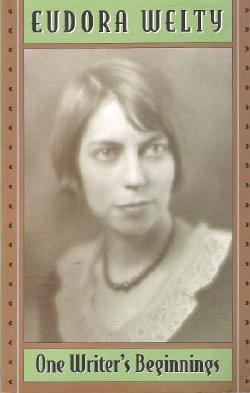
One Writer's Beginnings by Eurdora Welty

Yes, this is the actual cover.  And yes, I spent time reading it in the hot tub at my health club.  It was worth it.

Stephen Koch recommended this book at the end of his (review here) and I'm so glad he did.  The content of "One Writer's Beginnings" was birthed out of a set of three lectures Welty gave at Harvard University in 1983.  It is mostly memoir, while using her life experiences to teach about writing fiction.  The analogies she makes are poignant and well-timed; challenging, yet accessible.  And while it is brief (104 pages), it is also powerful.

Welty focuses mostly on memory and relationships.  Her own memory, she says, "...is the treasure most dearly regarded by me, in my life and in my work as a writer."  She proposes that all of our characters, all of our stories, come from our memories of our life experiences.  We create the unknown from that which is known.  I really appreciate this perspective, because I believe it to be true.  And Welty admits that we may not even realize it until years later, when we read the story again, where the ideas or patterns or themes came from.  "There would be no way to know this," she says, "for during the writing of any single story, there is no other existing." 

Welty's use of language is mesmerizing.  Time after time I shook my head at a simple turn-of-phrase.  "A good snapshot stopped a moment from running away," she says, sharing what photography taught her about writing.  "And I felt the need to hold transient life in words - there's so much more of life that only words can convey - strongly enough to last me as long as I lived."  Welty's dry wit made me smile, and outright laugh, at times.

Welty wrote this book in her seventies and the love and admiration for her family, especially her parents, is clear and powerful.  I didn't notice the dedication to her parents until after I finished the book, but when I saw it, it made all the sense in the world.  She talks a lot about what she learned from her parents, but what struck me most was their desire to facilitate Eudora's love of reading.  If nothing else, I was inspired to start reading "The Lion, The Witch, and The Wardrobe" to my six-year old son (we read chapter one tonight).  I want my children to read and to love doing it.  I want them to become a part of the stories they read and to be fascinated by words and how they fit together to make things interesting.  I aspire to be to my children who Eudora Welty's parents were to her.

This is a beautifully and intelligently written memoir; one that will engage any fan of the genre. 

Sunday, August 8, 2010

The Modern Library Writer's Workshop: A Guide to the Craft of Fiction by Stephen Koch

Though I've not ventured far into the forest of fiction writing, Stephen Koch's guide to writing it has prepared me to do so. And though nonfiction writing is where I spend most of my time, Koch reveals the closeness of the two when he says, "It lurks near the secret heart of many a project. There is an unwritten novel silently brooding over most works of nonfiction, just as there is a true story lurking in the shadows of almost every novel or short story. The two hover near each other. To embark on one is to sense the other. This is because of their common source in the merger of imagination and fact. Reach into it and you will touch something alive, something central to the art of storytelling" (p.136). So, regardless of the arena of writing in which you find yourself, expect improvement after reading Koch's guide.

Koch relies heavily on quotes from notable authors (Hemingway, James, King, Highsmith, etc.), which lends credibility to his advice. His writing is clear and concise, not coincidentally two traits he pushes for throughout the book to ensure good writing. The sections about structure, style and voice, and revision/re-writing were particularly strong. Koch gives us permission, as it were, to dispel the fear and trepidation we have as writers by giving us encouragement and confidence that we are not alone in our journey toward improvement. Sometimes we'll get lost and need to re-examine the structure of our work. Perhaps we're worried that our voice will only be a hodge-podge of the authors we admire. Maybe the revision of our work is Everest. Koch helps us understand the normalcy of these worries, and others, and gives us good advice about what to do with them.

Overall, Koch's offering is an indispensable resource for any writer. Additionally, I've already used the index numerous times; an appreciated extra for such a relatively slim volume. This guide may have a long title, but it remains a quick and powerful read that will be pulled from your bookshelf often.

Sunday, May 2, 2010

Tithing by Douglas LeBlanc

Tithing, by Douglas LeBlanc, left me wanting more. In the book, LeBlanc provides eleven different perspectives on tithing by interviewing people from drastically different backgrounds and finding out how it has affected their lives. This is NOT a how-to book, which is what I thought it would be given the "Ancient Practices" series name. Overall, the book seemed disjointed and a bit fluffy. LeBlanc seems like a nice guy and the people he interviews are interesting, but the practice of tithing seems loosely tied to most of their stories, at best.

In fact, the recounting of his time with Kevin Jones doesn't mention the practice of tithing once! At various points in the book, the importance of tithing is even disputed. On page 126 (in the same paragraph) LeBlanc quotes Yisroel Miller as saying, "...giving tithes is a commandment, a fulfillment of God's will," and two sentences later, "To give a tithe of one's income may be very difficult for some people, and it's generally not seen as a binding obligation that everyone must do. It is something to be encouraged, though." If it's not contradictory, it's at least confusing.

LeBlanc seemed to focus more on telling the stories of his interviews (which was rather distracting, to be honest) than on giving the reader any actual information about tithing. In one of the interviews, Mark Kellner says, "As far as I know, there's no mention in Scripture of tithing on money." As far as he knows? As a reporter, doesn't LeBlanc have the responsibility to research and answer that statement? It is, after all, a book about tithing.

I admit to being a bit of a cynic, but there were points in the book where the theme seemed to be, "If you tithe, God will give you what you want; if you don't, He'll make sure terrible things happen to you." That is much too simplistic for my taste.

For as disappointed as I was in the book overall, there were some good points, too. They were just a bit too hard to find. LeBlanc does point out that tithing is less about money and more about the heart. Tithing positions us humbly before God as our provider, which is always a good thing.

If you're looking for material that will actually instruct you on how to tithe or the biblical basis for it, this is not what you're looking for. If you're looking for stories that have a bit to do with how peoples' lives have been affected by tithing, and a couple hours to spare, you might like this book.

Disclosure of Material Connection: I received this book free from Thomas Nelson Publishers as part of their BookSneeze.com book review bloggers program. I was not required to write a positive review. The opinions I have expressed are my own. I am disclosing this in accordance with the Federal Trade Commission’s 16 CFR, Part 255 : “Guides Concerning the Use of Endorsements and Testimonials in Advertising.”

Tuesday, January 26, 2010

50 Ways To Feel Great Today

An easy read, 50 Ways To Feel Great Today delivers just what the title says it does. While most of the ideas are fairly straightforward and none of them particularly groundbreaking, authors David Biebel, James Dill and Bobbie Dill put a lot of thought into their offering. Sometimes it felt like there was too much thought, though. In fact, at over 200 pages, the book got to be a bit cumbersome. I suppose if you just read a chapter a day, it wouldn't seem as fluffy. Also, while the quotes and scripture references and stories were fine, oftentimes they felt a bit forced into their section. For instance, a quote from Bertrand Russel, author of Why I Am Not A Christian, leads off chapter 12, which seemed quite out of place. While I had trouble with the length and disjointedness of the book overall, there were still some good ideas. “Kidnapping” someone you love, planning a treasure hunt for a child you care about, tracing your ancestry, and my personal favorite, taking a nap, are all great ideas to make yourself feel great. And while most of the ideas suggested will not fix any of the situations that are keeping you stressed, worried or blue, they will bring a smile to your face and divert your attention for a time. And we can all use a happy diversion from time to time.


Available December 2009 at your favorite bookseller from Revell, a division of Baker Publishing Group.

Saturday, January 23, 2010

How To Inherit The Earth by Scott A. Bessenecker

With How To Inherit The Earth, author Scott A. Bessenecker set out to “write a critique of the Christian infatuation with leadership.” Instead, he added his own contribution to the mix. Even if it was by accident, as he says, we are the better for it.

Bessenecker does explore the near obsession with leadership material in Christian bookstores today, but not just as mere observation. He asserts that our focus should be on becoming effective followers of Christ, and less on becoming effective leaders. Bessenecker points out that even the apostle Paul “was more concerned with the exercise of excellent servanthood than he was with excellent leadership” and clearly communicates the need for Christians to do the same. By becoming effective followers of Christ, we are able to lead from a place of love and humility. “Followers of Jesus should be preoccupied by an ambition to outdo one another in sacrificial love, respect, obedience and submission,” he says.

Bessenecker explains the MONOPOLY (TM) mindset and “biggering” that dominates the West and has infiltrated our churches and leadership structures. He explains why it flies in the face of the downward mobility that is required of Christians. While Bessenecker emphasizes the need for a renewed focus on becoming better followers, he never questions the necessity of leadership; only how it is defined and implemented. He says, “We want to come under meek leaders, destined to inherit the earth because they lead with love, are mindful of the powerless and feel the spiritual weight of their position.”

Bessenecker uses personal stories, self-deprecating humor and brutal honesty to get his points across, often sharing his personal struggles and failures to punctuate an idea. In particular, I found his thoughts on wealth, comparison and entitlement, and how they impact our lives as believers, to be challenging and insightful. He suggests we should live a life defined by meekness, submission, repentance, following, slavery and obedience in order to flourish spiritually. It looks good in print, but, as Bessenecker would likely agree, is quite challenging to live out. Hopefully, we are up to the challenge.


http://www.urbana.org/blogs/blog.main.leastofthese.cfm

(Book provided by IVP)

Saturday, January 16, 2010

Introverts in the Church by Adam S. McHugh

In his book, “Introverts in the Church,” author Adam S. McHugh admirably represents those of us that are sometimes perceived as “the Eeyores of the social scene.” Not only does he give voice to how introverts think, feel and process, but he lays a solid foundation of how to experience healing, embrace our introvertedness, and be ourselves in ministry and as church-goers.

McHugh explains the extroverted nature of the American church today and the expectations that our leaders must be extroverted in order to do their job. He then debunks those sentiments. While extroverts excel in many areas of leadership, there needs to be a balance, which introverts provide. He then clearly and compellingly describes how the introverted personality affects our spiritual lives, our relationships to others and our community, our ability to lead and my favorite topic, introverted evangelism. The practical advice he gives for our approach to evangelism is indispensable.

There are times I have read a book that I so identify with that I think, “He took the words out of my mouth!” This was one of those books. I can't count the number of times I said to myself, “That's me!” It was such a good feeling to know that someone else “gets it.” It was empowering to be encouraged and instructed on how to embrace who I am. McHugh has done a tremendous service to the Christian community at large and I for one appreciate his efforts.


http://www.introvertedchurch.com/

(Book provided by IVP)