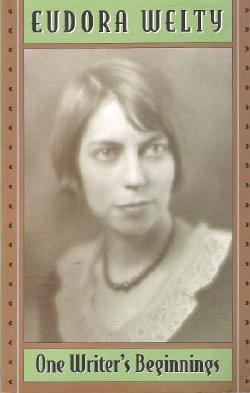
Stephen Koch recommended this book at the end of his (review here) and I'm so glad he did. The content of "One Writer's Beginnings" was birthed out of a set of three lectures Welty gave at Harvard University in 1983. It is mostly memoir, while using her life experiences to teach about writing fiction. The analogies she makes are poignant and well-timed; challenging, yet accessible. And while it is brief (104 pages), it is also powerful.
Welty focuses mostly on memory and relationships. Her own memory, she says, "...is the treasure most dearly regarded by me, in my life and in my work as a writer." She proposes that all of our characters, all of our stories, come from our memories of our life experiences. We create the unknown from that which is known. I really appreciate this perspective, because I believe it to be true. And Welty admits that we may not even realize it until years later, when we read the story again, where the ideas or patterns or themes came from. "There would be no way to know this," she says, "for during the writing of any single story, there is no other existing."
Welty's use of language is mesmerizing. Time after time I shook my head at a simple turn-of-phrase. "A good snapshot stopped a moment from running away," she says, sharing what photography taught her about writing. "And I felt the need to hold transient life in words - there's so much more of life that only words can convey - strongly enough to last me as long as I lived." Welty's dry wit made me smile, and outright laugh, at times.
Welty wrote this book in her seventies and the love and admiration for her family, especially her parents, is clear and powerful. I didn't notice the dedication to her parents until after I finished the book, but when I saw it, it made all the sense in the world. She talks a lot about what she learned from her parents, but what struck me most was their desire to facilitate Eudora's love of reading. If nothing else, I was inspired to start reading "The Lion, The Witch, and The Wardrobe" to my six-year old son (we read chapter one tonight). I want my children to read and to love doing it. I want them to become a part of the stories they read and to be fascinated by words and how they fit together to make things interesting. I aspire to be to my children who Eudora Welty's parents were to her.
This is a beautifully and intelligently written memoir; one that will engage any fan of the genre.

